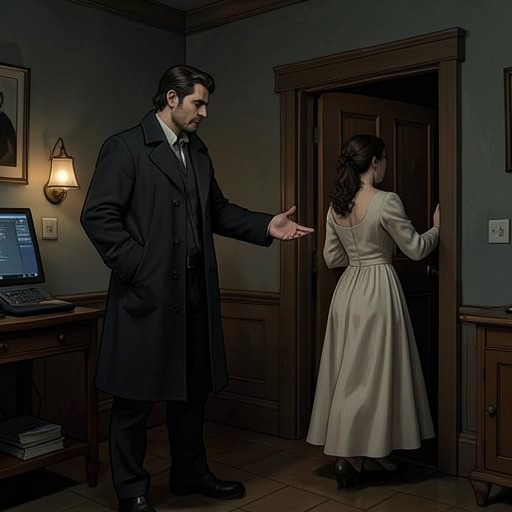
Rostov Finds Duel Pistols in the Manager's Office
A Gentleman in MoscowRostov Finds Duel Pistols in the Manager's Office is a small act of discovery shaped by a larger question: what becomes of beautifully made things when the world no longer has use for them? In the manager’s office, Count Alexander Ilyich Rostov studies a series of foxhunt engravings, considers the obsolescence of their traditions, and finds a concealed cabinet containing the dueling pistols Grand Duke Demidov had described. The discovery joins interpretation to action: Rostov recognizes the hidden compartment because he has just been thinking about objects whose usefulness has passed.
The Engravings and the Question of Use
Rostov approaches three prints depicting successive phases of a foxhunt: “The Scent,” “Tallyho,” and “The Chase.” The middle engraving holds his attention. Its young hunter wears stiff black boots and a bright red jacket, and blows a brass horn that turns a full 360 degrees from mouthpiece to bell. The instrument is presented as an accomplished object, expressive of both beauty and tradition. Yet Rostov tests that aesthetic value against practical necessity: does the modern world still need the horn, the elegantly dressed hunting party, the purebred horses, and the trained dogs required to corner a fox in its hole? His answer is no.
That judgment does not mean the objects are poorly made or without history. The tension is precisely that they are carefully crafted and still no longer essential. Rostov reflects that change is relentless and inventive, and that it exposes the obsolescence of old honorifics and hunting horns alongside silver summoners, mother-of-pearl opera glasses, and other fine possessions that have outlived their usefulness. The range of examples makes the thought larger than the foxhunt: an object can preserve skill and tradition while losing its former place in the world.
From Reflection to Search
The phrase “Carefully crafted things that have outlived their usefulness” returns in Rostov’s thought, followed by an unfinished “I wonder . . .” The pause turns general reflection into an opening for recognition. The narrative does not present his discovery as a sudden accident; it follows the association between outmoded objects and something whose existence he has reason to consider. The concealed pistols have been described by Grand Duke Demidov, and Rostov’s attention to the office’s furnishings gives him a way to look for them.
Before acting, Rostov moves quietly to the door and listens. Outside, he hears the manager, Arkady, and a third person speaking. Their muffled voices suggest that they have not yet resolved their discussion, and Rostov judges that they are still a few steps from doing so. He returns to the wall rather than interrupting them. The detail gives his search a practical constraint: he has a brief interval in which to inspect the engravings and test the place where the hidden compartment is meant to be.
The Concealed Cabinet
Rostov counts two panels beyond the engraving of “The Chase” and pushes the center of one. The panel gives slightly beneath his hand. A click follows; when he draws back his fingers, the panel pops open and reveals a hidden cabinet. Inside is an inlaid box with brass fittings, matching Grand Duke Demidov’s description. Rostov lifts its lid gently and finds the carefully made pistols resting within it.
The sequence is precise: count the panels, press the center, hear the click, and open the box. The concealed mechanism is not exposed by force or by dismantling the wall, but by locating the right panel and applying a measured push. The quietness of the action contrasts with the weapons themselves, while the brass fittings and inlay continue the passage’s attention to workmanship. Rostov’s response, “Marvelous,” followed by “Simply marvelous,” registers his admiration for the discovery and its craft; it does not erase the earlier question of whether such objects remain useful.
Meaning of the Discovery
The scene makes the office’s decoration part of its plot. The foxhunt prints first invite Rostov to consider the gap between beauty and necessity; their arrangement then guides him to a concealed store of weapons. The image of “The Chase” marks the point beyond which he counts, so the artwork that represents an old pursuit also serves as the visual reference for uncovering the pistols. The wall’s decorative surface is both an argument about the past and a cover for something preserved within it.
The discovery therefore holds two judgments together without resolving them into one. The pistols are carefully fashioned and hidden with evident deliberation, qualities that make them objects of admiration; their concealment also sets them apart from things openly used in the present. Rostov has not merely found an object that was missing from view. He has found the material answer to his own wondering, in a scene where attention to beauty, awareness of change, and knowledge supplied by Grand Duke Demidov converge in a single quiet act.